

For many schools, student administration and online learning happen in two different systems.
The Student Information System manages enrollment, student records, schedules, attendance, grades, and other administrative information. The Learning Management System manages course content, assignments, assessments, and the learning experience.
That separation is common, but it can also create extra work.
When your SIS and LMS are part of the same platform, information can follow the student from enrollment into the classroom and ultimately into their academic record, without staff having to manage the same information across multiple systems.
What happens when the systems are separate?
Consider what happens when a new student enrolls in a course.
With separate systems, the student may first need to be enrolled in the SIS and then given access to the appropriate course in the LMS. Course information and instructor access need to be kept aligned between the two systems.
Once the course begins, attendance, assignments, assessments, and grades may be recorded in the LMS, while the student's official academic record remains in the SIS.
Integrations can help connect these systems, but schools are still managing two platforms and the flow of information between them.
An integrated SIS and LMS changes that workflow.
1. Enrollment can lead directly into the classroom
When course administration and learning tools are connected, enrolling a student in a course can give them access to the same course instructors are already using to teach.
There is no separate learning environment that needs to be kept aligned with the student's enrollment record.
For staff, that means fewer places to manage course access. For students, it means their academic information and learning experience can be accessed through the same portal.
2. Course content lives alongside the course record
An integrated LMS doesn't just mean uploading a few documents to an SIS.
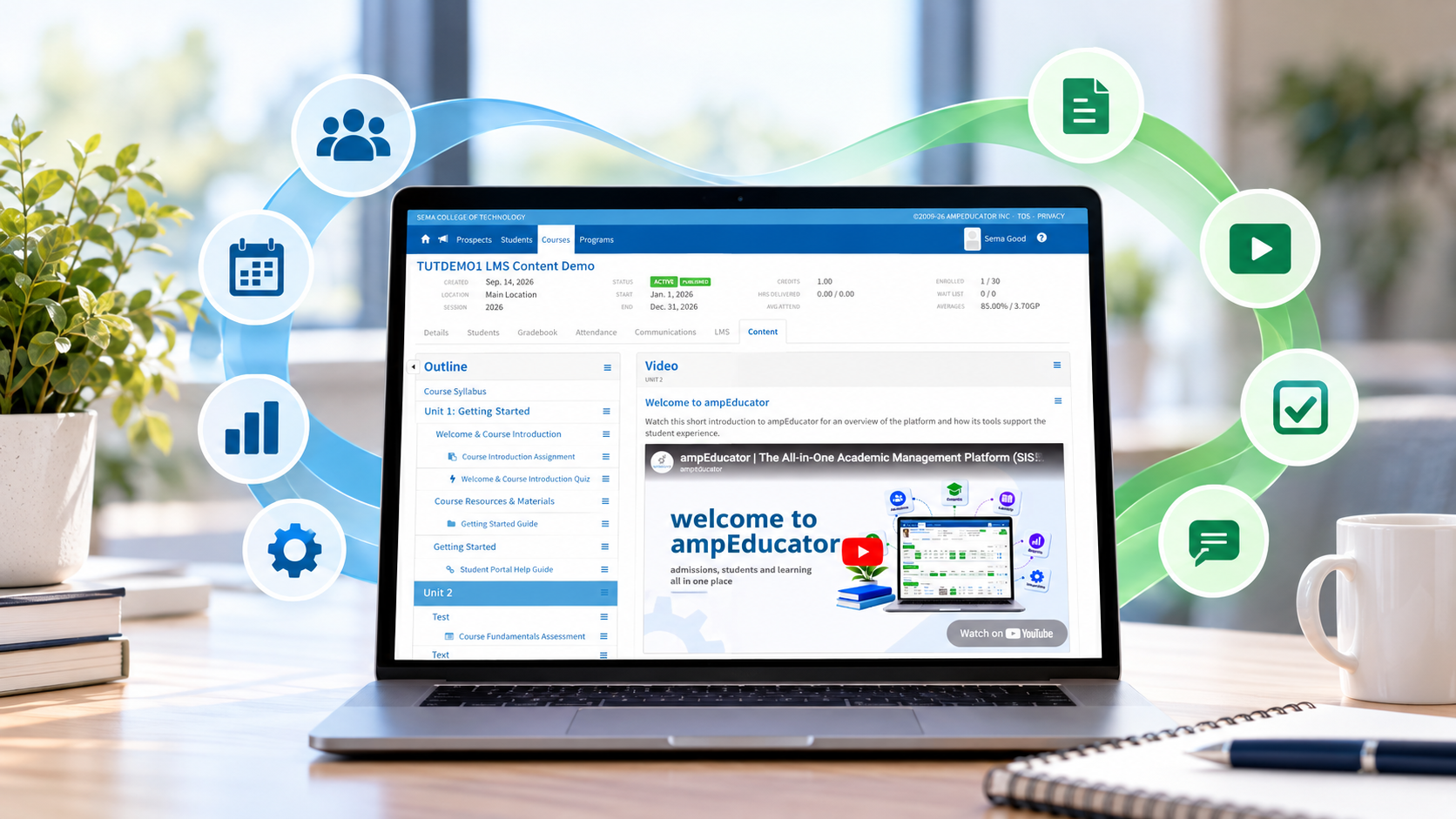
In ampEducator, instructors can organize course content into Units and Sections and add materials such as text, documents, links, assignments, tests, and quizzes.
That means a student can move through their learning materials within the same course where their enrollment, attendance, grades, and other academic information are being managed.
Instructors aren't switching between an administrative course in one platform and a teaching course in another.
3. Assessments can connect directly to the gradebook
Think about what happens after a student completes an assessment.
If the assessment is delivered in one system but the official grades are maintained somewhere else, information may need to be synchronized, exported, imported, or entered again.
With the learning and academic tools connected, assignments, tests, evaluations, attendance, and other graded activities can all contribute to the course gradebook.
Some results can also be calculated automatically, reducing another layer of manual administration.
4. Attendance becomes part of the same academic picture
Attendance is often more than a classroom checklist.
Schools may need attendance information for academic monitoring, program requirements, transcripts, reporting, or compliance.
When attendance is recorded within the same system as the student's courses and academic record, staff don't need to piece that information together from another platform.
It also becomes easier to look at attendance alongside grades and course progress when trying to understand how a student is doing.
5. Staff can see more than a final grade
A final grade tells you the outcome of a course, but it doesn't necessarily tell you what happened along the way.
With learning and student information connected, schools can have access to information such as course progress, engagement, attendance, assessments, and grades without gathering it from separate systems.
For example, if a student's performance begins to decline, staff can look beyond the final grade and consider whether attendance, engagement, or course progress may also require attention.
That creates a much more useful picture for instructors, advisors, and administrators.
Does every school need an integrated LMS?
Not necessarily.
A school with highly specialized learning requirements may need a dedicated LMS with functionality specific to its programs. And if an existing LMS is deeply embedded in your school's processes, an integration with your SIS may be the right approach.
But it's worth asking whether maintaining two platforms is actually providing additional value.
If most of what your school needs is course content, assignments, assessments, grading, attendance, communication, and student progress tracking, having those tools within your SIS could eliminate a significant amount of unnecessary complexity.
One student journey, instead of two systems
The real benefit of bringing an SIS and LMS together isn't simply having fewer pieces of software.
It's what happens to the information.
A student can move from enrollment → course access → learning content → assessments → attendance and grades → academic record without their information having to make the same journey between separate platforms.
ampEducator combines Student Information System and Learning Management System functionality in one platform, while also supporting integrations with external learning systems for schools that need them.